

IEC 62443-4-1 Secure Product Development Lifecycle
IEC 62443-4-1 is the part of the IEC 62443 series that covers how to develop secure products for industrial automation and control systems (IACS). It sets specific requirements for the secure product development lifecycle (SPDL) so that cybersecurity becomes part of the development process itself. This lets manufacturers and developers build security into their products from the start.
Contents
Concept and structure of IEC 62443-4-1
IEC 62443-4-1 is based on the concept of security by design. The aim is to build cybersecurity into every development phase, from requirements analysis through design and implementation to testing, release, and maintenance.
The standard groups its requirements into eight practices:
- Security management
- Specification of security requirements
- Secure design
- Secure implementation
- Security verification and validation
- Management of security-related issues
- Security update management
- Security guidelines
Each practice contains several detailed requirements that describe the processes and activities for secure product development.
Defense in depth
A central concept in IEC 62443-4-1 is defense in depth. This principle requires several layers of security to protect a system. If one security measure fails or is bypassed, further layers of protection remain.
In practice, this means developers should not rely on a single security measure. They should combine different security mechanisms at different levels of the system, for example network segmentation, access control, encryption, and logging.
Maturity levels
IEC 62443-4-1 introduces the concept of maturity levels. They describe how well an organization implements the requirements of the standard. There are four levels:
- Initial: processes are ad hoc and often undocumented.
- Managed: processes are documented and applied consistently.
- Defined: processes are standardized and applied across the whole organization.
- Improving: processes are continuously improved based on metrics and feedback.
These levels let organizations measure their progress in implementing the secure development process and improve it step by step.
In IEC 62443-4-1 certifications, the maturity level is assessed and stated on the certificate.
How mature is your development process?
The maturity levels of IEC 62443-4-1 show whether secure product development happens only in places or is already built into the organization. Not sure where your development organization stands and which gaps to close first? Book a call.
Requirements of IEC 62443-4-1
IEC 62443-4-1 organizes its requirements into the eight practices listed above:
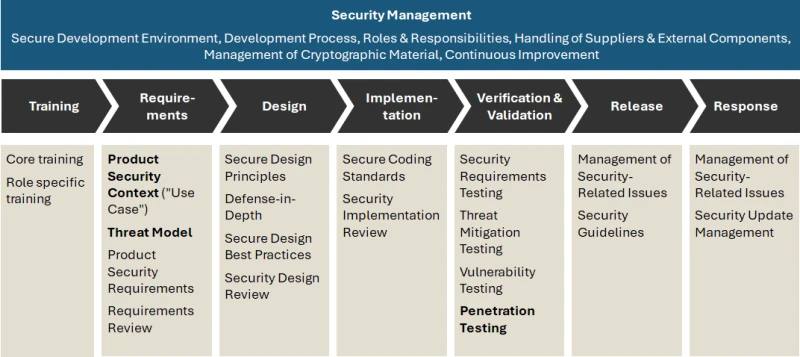
Security management
This practice is the foundation of the entire secure development process. It covers establishing and maintaining overall security management in the organization. This includes defining roles and responsibilities for security tasks, ensuring sufficient security expertise in the team, setting security policies and processes, and continuously improving these processes. Protecting the development environment itself and handling cryptographic material securely also belong here.
Specification of security requirements
This practice focuses on defining clear and complete security requirements for the product under development. It includes creating a threat model that identifies potential attacks and vulnerabilities, and defining the security context in which the product will be used. Based on these, the team formulates the specific security requirements the product must meet. These requirements are reviewed thoroughly to make sure they are complete and feasible.
Secure design
This practice is about applying security principles in the product design. A central concept here is the defense in depth strategy, which provides several layers of protection. The design must consider all interfaces of the product and define security aspects such as access control and data validation for each one. Regular security reviews of the design make sure that all security requirements are adequately addressed and that no new vulnerabilities have been introduced.
Secure implementation
This practice deals with turning the design into secure code. It covers defining and applying secure coding standards that avoid known vulnerabilities and insecure practices. Regular code reviews and static code analysis tools help ensure that these rules are followed and that the code contains no security flaws.
Security verification and validation
This practice checks whether the implemented security measures are effective. It covers several types of security testing: functional testing of the security requirements, threat mitigation testing, vulnerability testing, and penetration testing. An important aspect is that testers are independent of the developers, so that the assessment is objective.
A draft amendment to IEC 62443-4-1 (prAA) revises this practice and introduces security test grades. For details, see our article on security test grades in IEC 62443.
Management of security-related issues
This practice sets up processes for dealing with security issues found during development or after the product is released. It covers procedures for receiving and tracking security reports, assessing and prioritizing security issues, and developing and delivering fixes. Responsible disclosure of security issues to users is also part of this practice.
Security update management
This practice focuses on managing product updates securely. It covers processes for qualifying security updates, to make sure they fix the intended issues and introduce no new ones. Delivering updates securely to users and documenting the changes also belong here. An important aspect is providing critical security updates in a timely manner.
Security guidelines
The last practice covers the security documentation for users of the product. These documents, such as manuals, should enable secure integration, configuration, operation, and maintenance of the product. They include information on secure setup, system hardening, user and account management, and secure decommissioning of the product. Regular reviews keep these guidelines current and complete.
The following overview shows the requirements of each practice in a logical sequence:
How IEC 62443-4-1 relates to IEC 62443-4-2
IEC 62443-4-1 describes the process of secure development. IEC 62443-4-2 defines the specific technical security requirements for IACS components. The two standards complement each other:
- IEC 62443-4-1 defines how products should be developed securely.
- IEC 62443-4-2 specifies which security capabilities the finished products must have.
A product developed under IEC 62443-4-1 should be able to meet the requirements of IEC 62443-4-2. The processes of IEC 62443-4-1 make sure that the technical requirements of IEC 62443-4-2 are implemented and tested systematically.
IEC 62443-4-1 and the Cyber Resilience Act
IEC 62443-4-1 plays a central role in implementing the European Cyber Resilience Act (CRA). The CRA sets broad cybersecurity requirements for products with digital elements. IEC 62443-4-1 provides a detailed framework for a secure product development lifecycle.
IEC 62443-4-1 covers most of the process requirements of the CRA, because it addresses security management, requirements analysis, secure design and implementation, and the handling of vulnerabilities and updates. IEC 62443-4-1 does not explicitly require a software bill of materials (SBOM). Applying it consistently, however, often means you already collect the information an SBOM needs. A formal presumption of conformity is to come from the harmonized EN 40000 series instead, for the process requirements in particular EN 40000-1-2 and EN 40000-1-3.
For the technical requirements of the CRA, IEC 62443-4-1 alone is not enough. You need to add other standards, for example ETSI EN 303 645 and EN 18031, to cover all aspects. Overall, IEC 62443-4-1 gives organizations a solid basis for meeting the process requirements of the CRA and a structured approach to developing cybersecure products.
For more, see Using IEC 62443 to meet Cyber Resilience Act requirements.
Is IEC 62443-4-1 enough for your CRA preparation?
IEC 62443-4-1 covers many of the process requirements of the Cyber Resilience Act, but it does not replace a complete CRA assessment. Our check helps you see which requirements are already addressed and where additional measures, evidence, or technical requirements are missing.
Templates for implementing IEC 62443-4-1
Suitable templates make it much easier to implement a secure development lifecycle under IEC 62443-4-1. They give you a structured basis for the different aspects of security management, from requirements analysis to vulnerability management. Because they provide proven practices and structures, they can save organizations time and resources. You still need the right balance between standard templates and adjustments to your own organization.
Our article IEC 62443-4-1 templates compared gives a detailed overview of the available template packages, their pros and cons, and recommendations for choosing and using them. It compares several providers, including our own offering, and helps you decide which solution fits your requirements and resources.
What IEC 62443-4-1 gives manufacturers
IEC 62443-4-1 provides a complete framework for developing secure products. By applying its requirements consistently and reaching higher maturity levels, manufacturers can clearly improve the security of their products and make it verifiable. Together with IEC 62443-4-2, IEC 62443-4-1 is a solid basis for developing products that meet the growing requirements in industry.
Implement IEC 62443-4-1 in a structured way
If you want to introduce IEC 62443-4-1 in your development organization, improve your processes, or use it as a basis for CRA evidence, we support you with scoping, gap analysis, process design, and preparation for a possible certification.